

Graphic Diameter (G.DIA) in Colored Contacts: The Complete Size Guide
Graphic Diameter (G.DIA) in Colored Contacts: The Complete Size Guide
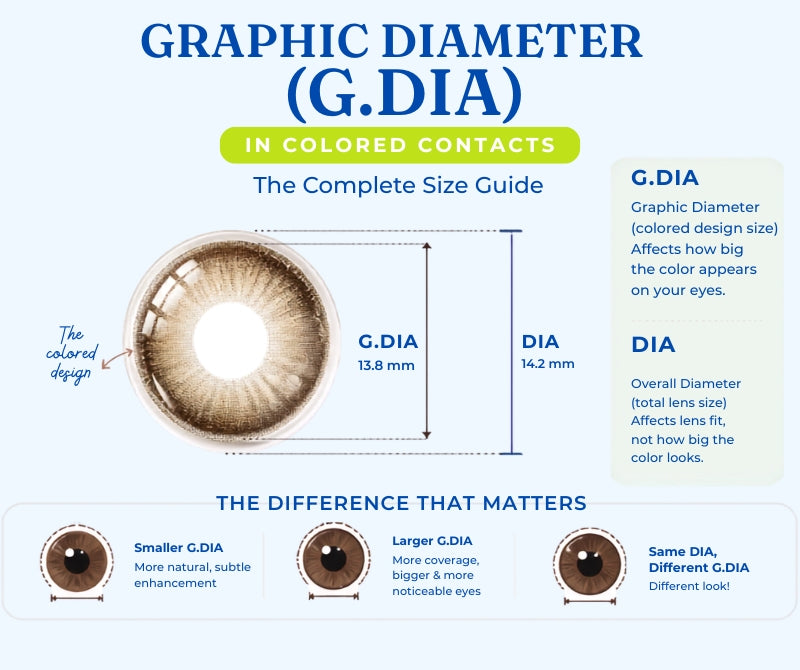
Graphic Diameter (G.DIA) is the diameter of the printed coloured design on the lens—not the overall lens size (DIA). It determines how much of your iris is covered and has the biggest influence on how natural or enlarging the lens appears.
The average human iris is about 11.8mm across. A lens with a G.DIA below that sits inside your natural iris and cannot enlarge your eyes at all. Everything above it extends past the edge of your iris, and that overhang is what creates the enlarging effect.

| G.DIA | Effect | Best for |
|---|---|---|
| Under 12.0mm | No enlargement — colour enhancement only | Realistic everyday wear, workplaces, first-time wearers |
| 12.0–12.5mm | Subtle definition, undetectable | Daily wear with subtle eye enlargement |
| 12.5–13.0mm | Noticeable but still natural | The most versatile everyday range |
| 13.0–13.5mm | Visibly larger, still wearable | Beauty looks, photos, going out |
| 13.5–14.0mm | Doll-eye effect, clearly noticeable | Circle lens styles, events, editorial |
| Above 14.0mm | Dramatic transformation | Cosplay, anime, costume |
G.DIA does not appear on your contact lens prescription. It is a design specification set by the manufacturer, listed on the product page.
Contents
- What graphic diameter actually is
- G.DIA vs DIA: the difference that matters
- Why the same lens looks different on different people
- What each G.DIA range looks like
- Dark eyes vs light eyes
- The limbal ring effect
- Comfort and safety
- Why G.DIA is missing from your prescription
- Choosing your size
- Frequently asked questions
What graphic diameter actually is
Every soft contact lens is a clear disc. On a colored lens, a pattern is printed onto part of that disc - a ring of pigment, usually with a darker outer edge and a softer inner blend, with a clear opening left in the middle so light can reach your pupil.
Graphic diameter is the width of that printed area, measured in millimetres from one outer edge to the other.
It is typically abbreviated G.DIA on product pages, sometimes written as "graphic diameter", "colour diameter", or "printed diameter". Values for cosmetic lenses generally fall between 11.5mm and 14.5mm.
The clear disc extends beyond the printed area in every direction. That is why a lens can have a 14.2mm DIA and a 12.8mm G.DIA at the same time — the plastic is 14.2mm wide, the colour is 12.8mm wide.
G.DIA vs DIA: the difference that matters
These two numbers are constantly confused, including by retailers. They do completely different jobs.
DIA (diameter) is the total width of the lens, edge to edge. It sits on your eye covering the cornea and part of the surrounding sclera. Most soft colored lenses are 14.0–14.5mm. DIA affects how the lens sits, how stable it is when you blink, and how it feels after eight hours. It is a fit specification.
G.DIA (graphic diameter) is the width of the coloured print. It is entirely cosmetic. It determines whether your eyes look untouched, slightly defined, or noticeably larger.
The practical consequence: two lenses with identical 14.2mm DIA can look completely different. One at 12.2mm G.DIA will read as your own eye colour, slightly enriched. One at 13.8mm G.DIA will read as an obvious change. The number most shoppers check tells them almost nothing about the result.
If a product page lists only DIA, it is not telling you what the lens will look like.
Understanding these specifications makes it easier to compare different lenses and choose the look you want. If you're unfamiliar with other lens measurements such as base curve, water content, or prescription power, read our Colored Contact Lens Specifications Explained guide.
Why the same lens looks different on different people
The horizontal visible iris diameter (HVID)—the width of the coloured part of the eye visible from the front—averages about 11.8 mm in adults. Although most adults fall close to this average, HVID varies much less than eye shape or facial features. This relatively consistent size is one reason standard soft contact lens diameters fit the vast majority of wearers, though proper fit also depends on factors such as corneal curvature and lens design
This gives you a simple rule:
If the G.DIA is smaller than your iris, the lens cannot make your eyes look bigger. The print sits entirely within your natural iris. All it can do is change or enrich the colour.
If the G.DIA is larger than your iris, the print extends past the limbus — the boundary between iris and white — onto what would otherwise be sclera. That overhang is the enlargement.
The enlarging effect is not a property of the lens in isolation. It is the difference between the lens's G.DIA and your own iris width. A 13.0mm lens produces roughly 0.5mm of overhang on someone with a large iris and roughly 1.1mm on someone with a small one — which is why the same lens genuinely looks more dramatic on some people.
What each G.DIA range looks like
Under 12.0mm — enhancement only
The print sits at or inside the iris edge for most wearers. There is no enlargement whatsoever. What you get is a colour shift and sometimes a little added depth or brightness.
This range is genuinely undetectable. Nobody will ask whether you are wearing lenses. It is the right choice for professional settings, for anyone nervous about looking obvious, and for people who like their eye shape and only want to change the colour.
The trade-off: on very dark irises, a small print area with soft pigment can look muted, because there is less surface for the colour to work with and your own pigment shows through at the edges.
12.0–12.5mm — subtle definition
Roughly 0.1–0.7mm of overhang for an average iris. Your eyes look a little more defined, a little more awake. Most people seeing this range on a stranger would register "nice eyes" rather than "contact lenses".
If you are buying your first pair of colored contacts and want something you will actually keep wearing, start here.
12.5–13.0mm — noticeable but natural
The enlargement is real and you will see it in the mirror, but it still reads as your own eye rather than as a lens. This is the most versatile band and where most everyday Korean and Japanese lenses sit.
If you want one pair that works for both a normal weekday and a night out, this is the range to shop.
13.0–13.5mm — visible enlargement
Clearly larger eyes. Still something you can wear to work or to dinner without it being the first thing anyone notices, but the effect is intentional and obvious in photographs.
This band photographs particularly well, which is why it dominates beauty and lifestyle content.
13.5–14.0mm — doll-eye
Unambiguous. The iris reads as noticeably oversized relative to the visible white of the eye. This is the classic circle lens look associated with Korean beauty and ulzzang styling.
Above 14.0mm — costume territory
Designed for transformation rather than enhancement. Anime, cosplay, characters, Halloween. These are not intended to look real and are usually not intended for all-day wear.
Once you've decided on the graphic diameter that suits your style, browse our full collection of colored contacts to compare natural, enlarging, and cosplay designs.
How G.DIA behaves on dark eyes vs light eyes
The same G.DIA produces different results depending on what is underneath it.
On dark brown or black eyes, the boundary between your natural iris and the printed overhang is high-contrast — dark iris, then coloured print, then white sclera. The enlarging effect reads more strongly, and the outer edge of the print is more visible. A 13.0mm lens on dark eyes generally looks bolder than the same lens on light eyes.
Dark eyes also need more opacity for the colour to show at all, and opaque prints have harder edges than translucent ones. The combination means dark-eyed wearers often get a more dramatic result than they expected from the numbers alone. If you have dark eyes and want subtlety, sit one band lower than you think.
On light eyes, translucent and enhancement prints blend into the existing iris pattern, which softens the edge and makes the overhang less obvious. Light-eyed wearers can usually go up a band before the effect becomes noticeable.
The limbal ring effect
The limbal ring is the darker band around the outer edge of a natural iris. It fades gradually with age, which is part of why large, well-defined limbal rings read as youthful.
Most colored lenses print an artificial one, and its design changes the perceived size independently of G.DIA:
- A dark, sharply defined ring makes the print read larger than it measures. It creates a hard border that the eye reads as the edge of your iris.
- A soft, graduated ring blurs that border and makes the same G.DIA read smaller and more natural.
- No limbal ring produces the most realistic result but the least definition, and on dark eyes can look washed out.
This is why a 13.0mm lens with a heavy black ring can look bolder than a 13.5mm lens with a feathered one. If you want the biggest visual impact from the smallest print, choose a defined ring. If you want the most natural result from a given size, choose a graduated one.
Does a larger G.DIA affect comfort or safety?
Graphic diameter itself does not touch your eye differently at 12mm or 14mm — the print is embedded within the lens material, and the lens edge that contacts your eye is determined by DIA, not G.DIA.
However, larger G.DIA lenses are usually built on larger DIA bases, and DIA does matter for fit. A lens that is too large for your cornea can sit too tightly, restrict tear exchange beneath the lens, and cause dryness or irritation over a long day. A lens that is too large relative to your eye opening will also be handled and blinked over more, which can shorten comfortable wear time.
There is a second consideration specific to heavily pigmented lenses. The printed area is less oxygen-permeable than the clear material around it. A very large print area means a larger portion of your cornea sits under pigment. In practice this is why silicone hydrogel matters more as G.DIA increases — the higher oxygen transmission of the material offsets the coverage.
Practical guidance:
- If you are new to lenses, start below 13.0mm and increase only if comfortable.
- For wear beyond six hours, prefer silicone hydrogel in the larger bands. Learn more about the differences between Silicone Hydrogel vs Hydrogel lenses before choosing your next pair.
- Any redness, dryness, blurring, or discomfort means remove the lens — regardless of how long you have owned it.
- Have your base curve and diameter checked by an eye care professional before committing to a size, particularly if you are considering anything above 14.2mm DIA.
Colored contact lenses are regulated as medical devices in the United States and require a valid prescription, including plano (non-corrective) lenses.
Why G.DIA is missing from your prescription
Your contact lens prescription contains SPH (power), BC (base curve), DIA (diameter), and — if you have astigmatism — CYL and AXIS. It will not contain G.DIA.
That is not an omission. A prescription describes what your eye needs medically. Graphic diameter is a cosmetic design choice made by the manufacturer, in the same category as which shade of brown the pigment is. Your optometrist fits you for base curve and diameter; you choose the print size.
The practical implication: you cannot ask your optometrist which G.DIA to buy and expect a number. You match your prescription for power, base curve and diameter, then select G.DIA based on the look you want.
Choosing your size
Work through these in order:
- Start from your prescription. Match SPH, BC and DIA first. Nothing else matters if the fit is wrong.
- Decide how visible you want the result to be. Undetectable, subtly defined, visibly larger, or transformative.
- Adjust for your iris. Smaller than 11.5mm, drop a band. Larger than 12.2mm, you can go up one.
- Adjust for your eye colour. Dark eyes, drop a band for the same perceived subtlety. Light eyes, you have room to go up.
- Check the limbal ring style. Defined ring reads larger; graduated ring reads smaller.
- Check the material if you plan long days — silicone hydrogel above 13.0mm.
As a rule of thumb, dropping or adding a band means moving 0.5mm. A 13.0mm lens on someone with a small iris looks roughly like a 13.5mm lens on someone average.
If you are between two options, choose the smaller. It is easy to want more enlargement after a comfortable first pair; it is expensive to be stuck with lenses you feel self-conscious in.
Frequently asked questions
What does G.DIA mean on contact lenses? G.DIA stands for graphic diameter — the width of the printed coloured area on a cosmetic contact lens, measured in millimetres. It controls how large your eyes appear.
What is the difference between DIA and G.DIA? DIA is the total width of the lens and affects fit and comfort. G.DIA is the width of the coloured print and affects appearance. A lens can have a large DIA and a small G.DIA.
What G.DIA looks most natural? Under 12.0mm produces no enlargement at all and is completely undetectable. 12.0–12.5mm gives subtle definition that still reads as natural on most people, and 12.5–13.0mm is noticeable without looking like a lens.
What G.DIA makes eyes look bigger? Anything above your own iris width, which averages 11.8mm. Visible enlargement begins around 13.0mm and becomes obvious above 13.5mm.
Is a larger graphic diameter less safe? G.DIA itself does not affect safety, but larger prints are usually built on larger overall diameters, and an ill-fitting diameter can cause dryness and irritation. Larger printed areas also reduce oxygen transmission, which is why silicone hydrogel is preferable in bigger sizes.
Why is G.DIA not on my prescription? Because it is a cosmetic design specification, not a medical one. Your prescription covers power, base curve and diameter; graphic diameter is your choice.
Can I wear a 14mm graphic diameter every day? It is possible but not typical. Above 14.0mm is designed for costume and event wear rather than daily use, and the visual effect is dramatic enough that most people reserve it for occasions.
Leave a comment
All comments are moderated before being published.
This site is protected by hCaptcha and the hCaptcha Privacy Policy and Terms of Service apply.