

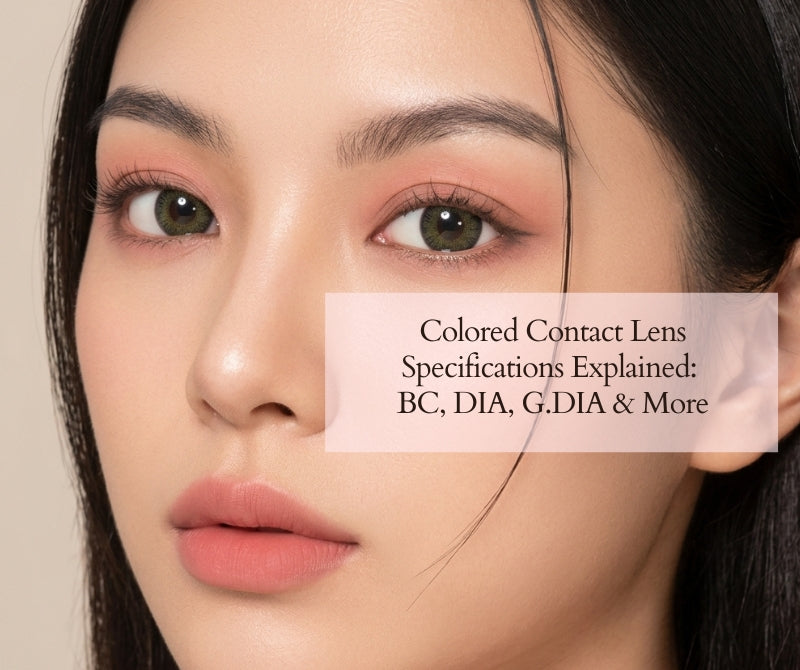
Colored Contact Lens Specifications Explained: BC, DIA, G.DIA & More
When shopping for colored contacts, most people focus on color, style, or before-and-after photos. However, understanding the specifications listed on a product page can be just as important as choosing the right shade.
Terms such as BC, DIA, G.DIA, water content, and replacement cycle may seem confusing at first, but they can have a significant impact on how your lenses look and feel.
This guide explains the most common colored contact lens specifications and how they affect comfort, appearance, and fit.
Understanding a Colored Contact Lens Specification

A colored contact lens may have specifications such as:
- BC: 8.6mm
- DIA: 14.2mm
- G.DIA: 12.8mm
- Water Content: 42%
- Replacement Cycle: Monthly
This tells you the lens has a commonly used base curve, a natural-looking graphic diameter, moderate water content, and is designed for monthly replacement.
Understanding these specifications can help you choose colored contacts that look natural, fit comfortably, and meet your vision needs. While some specifications affect comfort and fit, others influence how the lenses look on your eyes. Here's what each specification means and why it matters.
Base Curve (BC)
Base Curve, commonly abbreviated as BC, refers to the curvature of the contact lens.
Most soft colored contacts are available in a base curve range between 8.4mm and 9.0mm. At HoneyColor, many of our lenses feature an 8.6mm base curve, which is commonly used in soft contact lenses and designed to fit a wide range of wearers.
A properly fitted base curve helps the lens sit comfortably on the eye and maintain stability during wear. While many colored contact lenses are designed to fit a wide range of users, it is always best to follow your eye care professional's recommendation.
Lens Diameter (DIA)
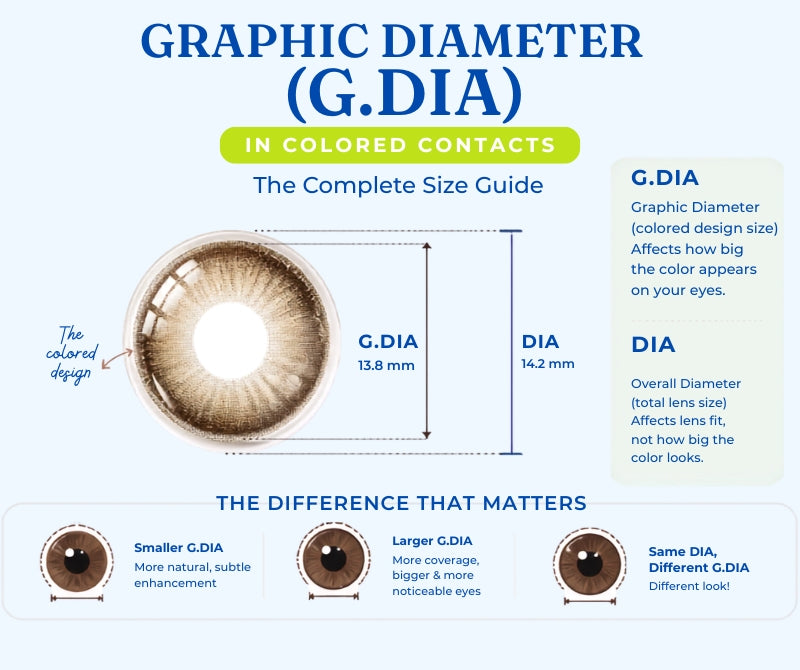
Diameter (DIA) refers to the overall width of the contact lens from edge to edge.
Most colored contacts have a diameter between 14.0mm and 14.5mm.
The overall diameter influences how much of the eye the lens covers, but it is not the primary factor that determines how large your eyes appear.
For that, you should look at Graphic Diameter.
Graphic Diameter (G.DIA)
Graphic Diameter (G.DIA) refers to the size of the colored pattern printed on the lens.
Unlike DIA, G.DIA directly affects the visual appearance of the lens and plays a major role in determining whether a lens looks natural, subtly enlarged, or dramatically enlarged.
Lenses with smaller graphic diameters are often preferred by those looking for the most realistic colored contacts.
If your goal is to achieve the most natural look possible, G.DIA is often one of the most important specifications to consider. Read our Graphic Diameter (G.DIA) in Colored Contacts: The Complete Size Guide
Water Content
Water content refers to the percentage of water contained within the lens material.
Water content varies by lens material and design. Many colored contacts contain between 38% and 55% water. At HoneyColor, many of our lenses feature 38%–42% water content, a range often chosen to balance comfort, durability, and lens stability.
Many shoppers assume higher water content automatically means greater comfort, but comfort depends on multiple factors, including lens material, oxygen transmission, and individual eye condition.
For example, some silicone hydrogel lenses provide excellent comfort despite having lower water content than traditional hydrogel lenses.
Lens Material
The material used to manufacture a lens can significantly affect breathability and comfort.
Hydrogel
Hydrogel lenses are soft, flexible, and widely used in colored contact lenses.
Benefits include:
- Comfortable wear
- Soft feel
- Wide variety of color options
Silicone Hydrogel
Silicone hydrogel lenses allow significantly more oxygen to reach the eyes.
Benefits include:
- Improved breathability
- Better oxygen transmission
- Enhanced comfort during long hours of wear
Many modern colored contact lenses now use silicone hydrogel materials to improve overall wearing comfort.
Replacement Cycle
Colored contacts are available in several replacement schedules.
Daily Lenses
Wear once and discard.
Best for:
- Convenience
- Travel
- Occasional use
Monthly Lenses
Replace every month.
Best for:
- Frequent wearers
- Cost-effective daily use
Quarterly Lenses
Replace every three months.
Best for:
- Occasional users
- Balance between convenience and value
Yearly Lenses
Replace after one year with proper care and maintenance.
Best for:
- Occasional wear
- Cosplay
- Special events
Always follow the manufacturer's recommended replacement schedule and care instructions.
Understanding Your Prescription
If you wear prescription colored contacts, you may see several abbreviations on your eye prescription.
OD and OS
- OD (Oculus Dexter) = Right Eye
- OS (Oculus Sinister) = Left Eye
These simply identify which prescription belongs to each eye.
SPH (Sphere)
SPH refers to the lens power needed to correct nearsightedness or farsightedness.
Negative (-) powers are used to correct nearsightedness (myopia), while positive (+) powers are used to correct farsightedness (hyperopia).
Examples include:
- 0.00 (Plano)
- -1.00
- -3.50
- -6.00
Most colored contact lenses are available in plano (0.00) and negative powers for myopia correction, while availability of positive powers may vary depending on the manufacturer and lens design.
To ensure the best fit, comfort, and visual clarity, always select the prescription recommended by your optometrist or eye care professional rather than estimating your lens power yourself.
CYL (Cylinder)
CYL measures the amount of astigmatism correction required.
AXIS
AXIS indicates the orientation of astigmatism correction and is measured in degrees from 1 to 180.
If your prescription includes CYL and AXIS values, you may require toric contact lenses rather than standard spherical lenses.
Which Specification Matters Most?
Every specification contributes to comfort and performance, but for cosmetic appearance, Graphic Diameter (G.DIA) is often the most influential factor.
While color determines the shade of the lens, G.DIA largely determines whether the result appears natural, subtly enhanced, or dramatically enlarged.
Unlike PWR, BC, or DIA, G.DIA is not included on a contact lens prescription. It is a design specification provided by the manufacturer that indicates the size of the printed color pattern on the lens.
Understanding both your prescription specifications and lens design specifications can help you choose colored contacts that not only look great but also feel comfortable throughout the day.
Final Thoughts
Choosing colored contacts involves more than selecting a color you like. Specifications such as BC, DIA, G.DIA, water content, material, replacement cycle, and prescription details all play a role in how the lenses fit, feel, and look.
Whether you're searching for natural everyday lenses, subtle enhancement styles, or options for astigmatism, understanding these specifications can help you make a more informed decision and find lenses that suit both your eyes and your lifestyle.
For the best fit, comfort, and visual clarity, always follow the guidance of your optometrist or eye care professional when selecting contact lenses. A better understanding of lens specifications not only helps you choose the right pair but also ensures a safer and more comfortable wearing experience.

Leave a comment
All comments are moderated before being published.
This site is protected by hCaptcha and the hCaptcha Privacy Policy and Terms of Service apply.